
RESEARCH, TRAINING AND DEVELOPMENT
Neutronix Nuclear Consulting Service (NNCS) excels in research and training across diverse fields beyond nuclear engineering and reactor physics. Recent publications have delved into radiation transport, encompassing nuclear criticality safety analysis, radiation protection, and radiation shielding.
In the domain of nuclear criticality analyses, ongoing research predominantly focuses on harnessing burnup credit (BUC) to address the mounting challenge of spent fuel storage space limitations, particularly for plants commissioned in the 1980s and earlier. Burnup credit analysis aims to showcase that by incorporating credit for specific nuclide groups into calculations, a reduction in spent fuel storage space relative to the fresh fuel scenario can be achieved.
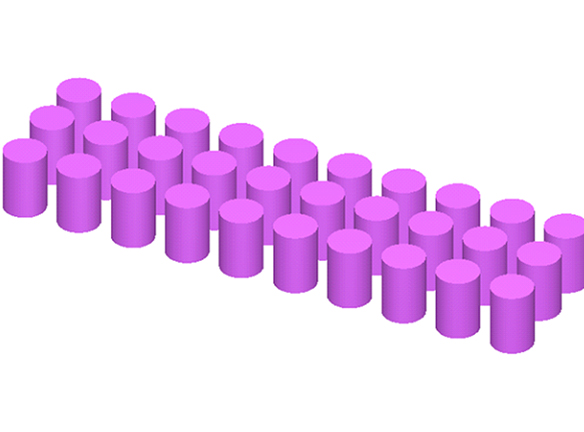
The level of savings in spent fuel storage space increases with the inclusion of a greater number of nuclides possessing high neutron absorption cross-sections. Furthermore, coupling burnup credit with a spent fuel storage matrix enhances these savings. The crux of spent fuel storage matrix analysis is rooted in the discovery that certain storage matrices may elevate the keff, while others may lower it. The former scenario necessitates more storage space to comply with the regulatory limit (i.e., keff < 0.95). Hence, this branch of research, namely spent fuel storage pattern analysis, aims to devise an optimal storage arrangement that minimizes storage space while ensuring keff remains below the regulatory threshold of 0.95.
Such analysis is inherently scientific and should precede spent fuel storage, considering factors like initial fuel enrichment, burnup history, and spent fuel cask design data. Consequently, decisions regarding the distance between casks or storage patterns should not be left to crane operators but should be integrated into spent fuel storage management and submitted to regulators for approval.

Spent Fuel Management
Spent fuel management encompasses analyses of spent fuel during storage and during transportation. Analysis for storage of spent fuel, whether it is interim storage or permanent disposal includes calculation of the most effective storage matrix/pattern that will ensure that the capacity of spent fuel storage facility is preserved while keeping the keff of the entire fissile below the prescribed 0.95 limit. The storage pattern analysis is performed for transportation of fresh fuel and for transportation of spent fuel.
Besides the application of storage matrix to optimize spent fuel storage facility, we also do burnup credit calculation to reduce the keff by taking into account the three common nuclides set (actinides only, actinides + minor fission products and actinides + principal fission product) which are used in a number of countries where the regulators has approved burnup credit (BUC) as an alternative form to reduce the keff. The economic benefit of taking credit for burnup is to recover storage space which would have been lost if fresh fuel scenario was applied.
In addition to addressing the reactivity aspect of the spent fuel, the other equally important aspect is the radiological health impact of spent fuel for which radiation shielding and public exclusion boundaries (PEB) are calculated to ensure no member of the public is exposed to undue radiological health risks.
Emergency Planning and Response Plan
The core function of the Emergency Preparedness and Response Program is to ensure the nuclear regulator that the Emergency Preparedness and Response Program (EP program) of the licensee is viable and effective, and its state of readiness will be maintained that way throughout the operational life of the nuclear plant. Its viability and effectiveness are tested regularly via regular Emergency Exercises. The primary objective of the Emergency Preparedness and Response Program is to ensure that, if in an unlikely event, a nuclear accident was to occur in any of the nuclear facilities, no member of the public will be exposed to undue radiological health risk because of the nuclear accident. All emergency preventive measures (distribution of iodine prophylaxes, evacuation, shielding, relocation) will be implemented within the prescribed time frame to limit severe health effects.